 Lily Pond Rhapsody
she knits and knits and knits and sometimes she spins too....
Tuesday, February 23, 2010
A Lovely Surprise
Lily Pond Rhapsody

Tuesday, February 16, 2010
Wool,Mohair & Alpaca
I never tire of spinning ,plying and creating a skein of yarn! It's wonderful to twist the skein and observe its color and feel its texture. Such a simple pleasure that precedes thoughts of what possibilities lie ahead. This skein could become a cowl or a shawl. I've got time to play with creative decisions. On the other hand it may simply be a lovely skein.


Friday, February 12, 2010

Tuesday, February 09, 2010

Saturday, February 06, 2010
Blooms in February
How much we depend on our houseplants to feed out souls while we wait for springtime.
My orchid is sending out its green stem which contains the young buds of future flowers. What joy...................

My orchid is sending out its green stem which contains the young buds of future flowers. What joy...................

Friday, February 05, 2010
Just in time!
Finished the baby jacket for my newborn grand nephew.Bulky yarn makes for a quick knit.
Back to the many UFO's hiding in bags.

Back to the many UFO's hiding in bags.

Thursday, February 04, 2010
JD Salinger
As a lover of literature and a English teacher for many years, I was grateful for the works for JD Salinger. I particularly enjoyed teaching the novel, The Catcher in the Rye to many high school students over the years. In today's Providence Journal Editorial section I read the article below. Cosell is right on the mark with her analysis of the novel as Holden's spiritual quest. If you've never read the novel pick it up. It's worth the read.

Hilary Cosell: To Allie, with love and squalor
01:00 AM EST on Thursday, February 4, 2010
NEW YORK Jan. 28, 2010
July 18, 1946
The first date marks the recent death of author J.D. Salinger. It was front-page news, along with the obligatory assessments of his literary output and opinions about his final resting place in American letters. Most of the conversations centered around his famous novel, “The Catcher in the Rye.” Does it stand the test of time? Is it still “relevant”? Or is it “dated” adolescent angst and alienation, penned by an alienated adult who chose to become a recluse?
I answer those questions with the second date, a date engraved forever on the psyche of Holden Caulfield, “Catcher’s” troubled adolescent narrator: the date that his brother Allie Caulfield died.
“He’s dead now. He got leukemia and died when we were up in Maine, on July 18, 1946. You’d have liked him. He was two years younger than I was, but he was about fifty times as intelligent.”
Salinger devotes less than two pages early in the novel to Allie’s death, and in a brilliant literary move, Allie is rarely mentioned by name after that. Yet he is everywhere in the novel, a misty presence, a motive force underlying Holden’s alienation, depression and misery. When Allie died, Holden slept in the garage at their summer home that night and proceeded to break all the garage windows with his fist. Then he tried but failed to break all the windows in the family station wagon, too. “It was a very stupid thing to do, I’ll admit, but I hardly didn’t even know I was doing it, and you didn’t know Allie.”
You didn’t know Allie. Is that really true? For it always seemed clear to me that the reader does indeed know Allie, if the reader can be persuaded to look beyond multiple references to sex, pimples, phonies and the disastrous meeting with Sunny the prostitute, to Holden’s shattering loss. A child brother, killed by cancer. A randomly chosen victim, for whom there was no cure and no savior.
“It was a very stupid thing to do, I’ll admit, but I hardly didn’t even know I was doing it.” To express deep pain in a violent and partly self-destructive act (his hand was mildly but permanently injured) may not be desirable, but nor is it “stupid.” Honesty should compel us to admit that such acts often take place as a last, desperate release of intolerable torment. It has never failed to both surprise and confound me that Allie’s death and Holden’s response to it are rarely, if ever, much explored in critical and classroom studies of the novel.
Near the end of the novel, Holden tells his sister, Phoebe, that if he had his choice he’d want to stand in a field of rye where thousands of little kids are playing. At the edge of the field is a cliff. Holden would be the only “big” person around, standing on the cliff’s edge.
“What I have to do, I have to catch everybody if they start to go over the cliff — I mean, if they’re running, and they don’t look where they’re going. I have to come out from somewhere and catch them. That’s all I’d do all day. I’d just be the catcher in the rye. I know it’s crazy, but that’s the only thing I’d really like to be.”
In typical Holden fashion, he may have the words wrong — the Robert Burns poem is, “If a body meet a body coming through the rye.” But Holden’s wish is not crazy in the least. His catcher in the rye makes utterly perfect sense. He could not save Allie from death. But as the catcher in the rye he can save all those other children at risk. It is a hope for salvation and redemption. Read more deeply, look beyond the universal adolescent angst that Salinger portrays so vividly, and you will find a universal spiritual quest. This writer suggests reading “The Catcher in the Rye” as Holden’s search for God in a godless world.
Salinger’s critics have bemoaned his obsession with children and with innocence. I’m not sure I would describe the clear-eyed, uncompromising Phoebe Caulfield, or the genius Glass children, stars of the “It’s a Wise Child” radio show, as “innocent.” Some critics have also derided Salinger’s increasing interjection of theology into his work, be it the “Jesus Prayer” and Christianity in “Franny and Zooey” or his later exploration of Hinduism, Zen Buddhism and other Eastern theologies in the Seymour writings.
But read “Catcher” carefully and the seeds of those later themes are planted in Holden’s story. Salinger’s evolution into theological themes should not necessarily be a surprise.
As James Joyce, a “theological author” if ever there was one, once said, “In the particular lies the universal.” The sacred is everywhere, if one just looks for it.
Thank you, Mr. Salinger, for giving us not only a glimpse of the sacred, but for your spectacular contribution to American literature and American life.
Hilary Cosell, an occasional contributor, is a Connecticut-based writer and a master’s-degree candidate at General Theological Seminary, in New York.
Tuesday, February 02, 2010
What I'm Reading

Mc Cullough's John Adams is a great read.......Especially the interesting details about Abigail's role in our country's early days of independence.
Sunday, January 31, 2010
Machines Can Knit Too!
Today thanks to Iris I had a grand lesson on a Knittrax knitting machine.With Iris's help I was able to knit a sock blank of 450 yards of sock yarn I purchased from RI Handspun.
She is seated at the machine demonstrating how to recover some stitches
Can't wait to dye it!


She is seated at the machine demonstrating how to recover some stitches
Can't wait to dye it!


Saturday, January 30, 2010
Time is on the run
How did it become January 30th? It is so true that time flies more quickly as the decades advance.
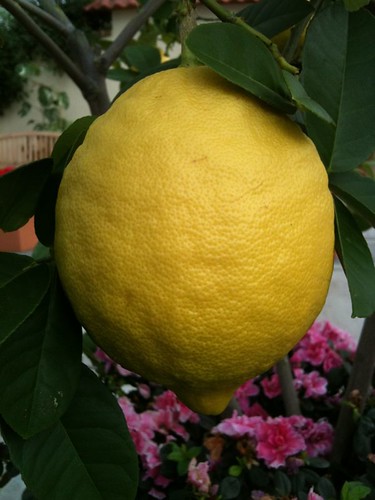
This means carpe diem without fail, folks. I've been reassessing what's important each day. Lately it's been painting, knitting spinning and writing. There's also photo shots at the local botanical gardens. We need the yellow in January!!

This means carpe diem without fail, folks. I've been reassessing what's important each day. Lately it's been painting, knitting spinning and writing. There's also photo shots at the local botanical gardens. We need the yellow in January!!
Thursday, January 21, 2010
Spindle Adoration

Ahhhhhh...... The joy of alpaca and silk moves through my fingers as I observe the whirling wooden tool that links me to the textile past of our ancestors.
Monday, January 18, 2010
Sunday, January 10, 2010
Changes
I've finally hunkered down to start another round of blog entries. It's about time, I think, to resume writing and picture taking. Problem is I got an iphone and I've being taking pics with it instead of my digital camera, and I need to establish a new upload routine. I downloaded Flickit to the phone and have been uploading pics to Flickr. This should clear the way to promoting more blogging. Well..................will see.
I've been in a quandry this new year with dealing with the loss of a dear friend and other issues. What has made it all possible for me to preserve my equanimity is family, friends and creative pursuits. Where would we be without them. EZ said to knit on through all crises, and she knew what she was talking about. Except I'm doing more..........creative writing, painting and dabbling in other fiber arts pursuits. Because in the words of Rose Tremain (b. 1943), British author: Life is not a dress rehearsal.
It's time for the fiber content, folks. Yesterday, I had the pleasure of listening to a presentation by Laurie Carlson at the RI Weavers Guild meeting who weaves using fiber optics. It's remarkable how she creates installations that utilize woven light. Take a look here.
After the presentation I was off to the our spinning guild meeting to spin some fiber yet to be photographed. I did manage to also spin some chocolate caramel fiber on my Ledbetter. I've got a sock in the making as well.
Happily I finished SIL's plain jane vest, but after the holiday. I also managed to use some autumn Navajo plyed fiber donated by a generous friend for a Fake Fair Ilse hat for DH.He said he likes it . When I mentioned using it for snow shoveling, he said I don't want to ruin the hat. "What!" I said. " Wool will keep you dry!" The uninitiated wool wearers of the world are all around us. Notice the Lindt 85% dark chocolate box upside down at the top left. I believe that baby is empty.

I've been in a quandry this new year with dealing with the loss of a dear friend and other issues. What has made it all possible for me to preserve my equanimity is family, friends and creative pursuits. Where would we be without them. EZ said to knit on through all crises, and she knew what she was talking about. Except I'm doing more..........creative writing, painting and dabbling in other fiber arts pursuits. Because in the words of Rose Tremain (b. 1943), British author: Life is not a dress rehearsal.
It's time for the fiber content, folks. Yesterday, I had the pleasure of listening to a presentation by Laurie Carlson at the RI Weavers Guild meeting who weaves using fiber optics. It's remarkable how she creates installations that utilize woven light. Take a look here.
After the presentation I was off to the our spinning guild meeting to spin some fiber yet to be photographed. I did manage to also spin some chocolate caramel fiber on my Ledbetter. I've got a sock in the making as well.
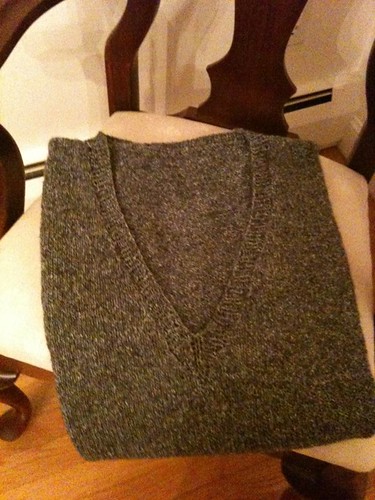
Happily I finished SIL's plain jane vest, but after the holiday.
 I also managed to use some autumn Navajo plyed fiber donated by a generous friend for a Fake Fair Ilse hat for DH.He said he likes it . When I mentioned using it for snow shoveling, he said I don't want to ruin the hat. "What!" I said. " Wool will keep you dry!" The uninitiated wool wearers of the world are all around us. Notice the Lindt 85% dark chocolate box upside down at the top left. I believe that baby is empty.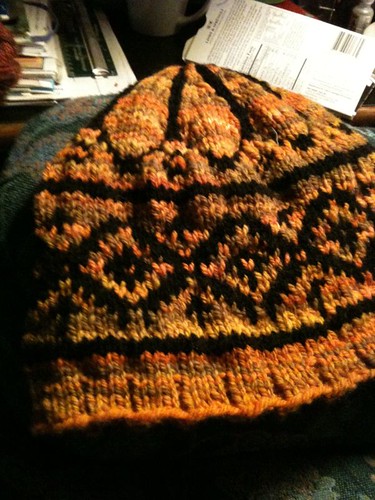
Sunday, January 03, 2010
Back in the Saddle Again
Yes, this has special meaning for me. Christmas Day I mounted DD's horse after over 40 years of shying away from riding. Don't get excited.... I only rode for a minute. It was a first lesson and no photographic evidence!
Believe what you will. Here is something to believe in......knitting:

This is Fake Fair Isle hat knit in some handspun autumn colored yarn and some Paton's Classic Merino in black.
Believe what you will. Here is something to believe in......knitting:

Saturday, December 05, 2009
Botanical Gardens
What a joy to visit gardens in December! The holiday display was delightful.I never knew there were so many varieties of
pointsettas.


pointsettas.


Thursday, December 03, 2009
Phone Blogging
I finally realized I need to post. So I thought I would try to post using my phone.Here's what DH has been up to.

- Posted using BlogPress from my iPhone
Saturday, October 31, 2009
Whirlwind Weeks
The last few weeks have been busy; hence my not being able to post. I was able to visit Rhinebeck for the weekend and partake of the fiber-filled atmosphere with friends and enjoy the much longed for goodies. I particularly enjoyed the Eveready Diner between visits to the fairgrounds!

 The end of last week I enjoyed visiting the Botanical Gardens at Roger Williams Park. I was captivated by the Koi pond and of course the lush vegetation that has happily helped to soothe the loss of spring and summer flora.
 Today I was able to celebrate Halloween at a local Spin In hosted by Sue D at RI Handspun. We had a good time spinning, knitting and gabbing. Paula was spinning some Halloween Fiber that was delightful. Judy spun some lovely blue singles and plyed them. Carol R spun some bouncy fiber on her wheel. DebbieR spun her Witches Brew. Carol M worked on a lovely lap robe using Starmore's Maidenhair pattern. Sue began a sweet pink baby hat. I spun some Pumpkin Cappuccino from CJ Kopec fiber that fit the autumn Halloween theme. The lighting is poor and does not show the truly warm autumn hues to best advantage. I'll have to think about what to make with the four ounces I am spinning.


 The end of last week I enjoyed visiting the Botanical Gardens at Roger Williams Park. I was captivated by the Koi pond and of course the lush vegetation that has happily helped to soothe the loss of spring and summer flora.
 Today I was able to celebrate Halloween at a local Spin In hosted by Sue D at RI Handspun. We had a good time spinning, knitting and gabbing. Paula was spinning some Halloween Fiber that was delightful. Judy spun some lovely blue singles and plyed them. Carol R spun some bouncy fiber on her wheel. DebbieR spun her Witches Brew. Carol M worked on a lovely lap robe using Starmore's Maidenhair pattern. Sue began a sweet pink baby hat. I spun some Pumpkin Cappuccino from CJ Kopec fiber that fit the autumn Halloween theme. The lighting is poor and does not show the truly warm autumn hues to best advantage. I'll have to think about what to make with the four ounces I am spinning.

Saturday, October 03, 2009
Rainy Day Blues
Ugh! It's cold and dreary this am. Luckily I had enough light in the Florida room to take pics of my latest finished projects. I tried without success to upload the pics and projects to Ravelry just before this post, but it appears to be a bit cranky this am.
The shawl is a lovely deep red. I used the Simple Yet Effective shawl pattern and made a few mods to the pattern.


The scarf is a drop wrap stitch pattern knitted in handpainted Ella Rae Merino............a delightful knit. Blocking it made a big difference.
The shawl is a lovely deep red. I used the Simple Yet Effective shawl pattern and made a few mods to the pattern.


The scarf is a drop wrap stitch pattern knitted in handpainted Ella Rae Merino............a delightful knit. Blocking it made a big difference.

Friday, October 02, 2009
I Know It's Fall
I know it's fall and all, but the summer got past me so quickly this year. It was a different summer, but delightful as well. I thoroughly enjoyed feasting on my heirloom Nebraska Wedding tomatoes. I actually grew peppers for the first time, and I had enough to stuff for a great supper addition! I planted some seeds from last year's Datura and I finally was rewarded today with one of its lovely trumpets.

On the weaving front I finished weaving 3 dishcloths on my Beka RHL. I really like the absorbancy of the fabric. On the knitting front, I've been working on a hodge podge of projects such as three cowls , a shawl and the scarf you see below not to mention trying to finish knitting my Ply by Night scarf made out of handspun alpaca, wool and angelina.

Last night I attended the Slater Mill Knit Guild meeting. Twist Collective presented their trunk show. As always seeing knitted garments sells patterns. Check out their website and archived patterns. You won't be disappointed.

On the weaving front I finished weaving 3 dishcloths on my Beka RHL. I really like the absorbancy of the fabric. On the knitting front, I've been working on a hodge podge of projects such as three cowls , a shawl and the scarf you see below not to mention trying to finish knitting my Ply by Night scarf made out of handspun alpaca, wool and angelina.

Last night I attended the Slater Mill Knit Guild meeting. Twist Collective presented their trunk show. As always seeing knitted garments sells patterns. Check out their website and archived patterns. You won't be disappointed.
Saturday, September 26, 2009
The Spinning Room
I came across this interesting article about the spinning rooms in 18th century Germany. It was there that people shared local news as well as news from travelers. They were even denounced: " as dens of iniquity because young, unmarried men and women would drink together, sing songs together, and perhaps even worse..."
Times have changed .............

Times have changed .............
Subscribe to:
Posts (Atom)